

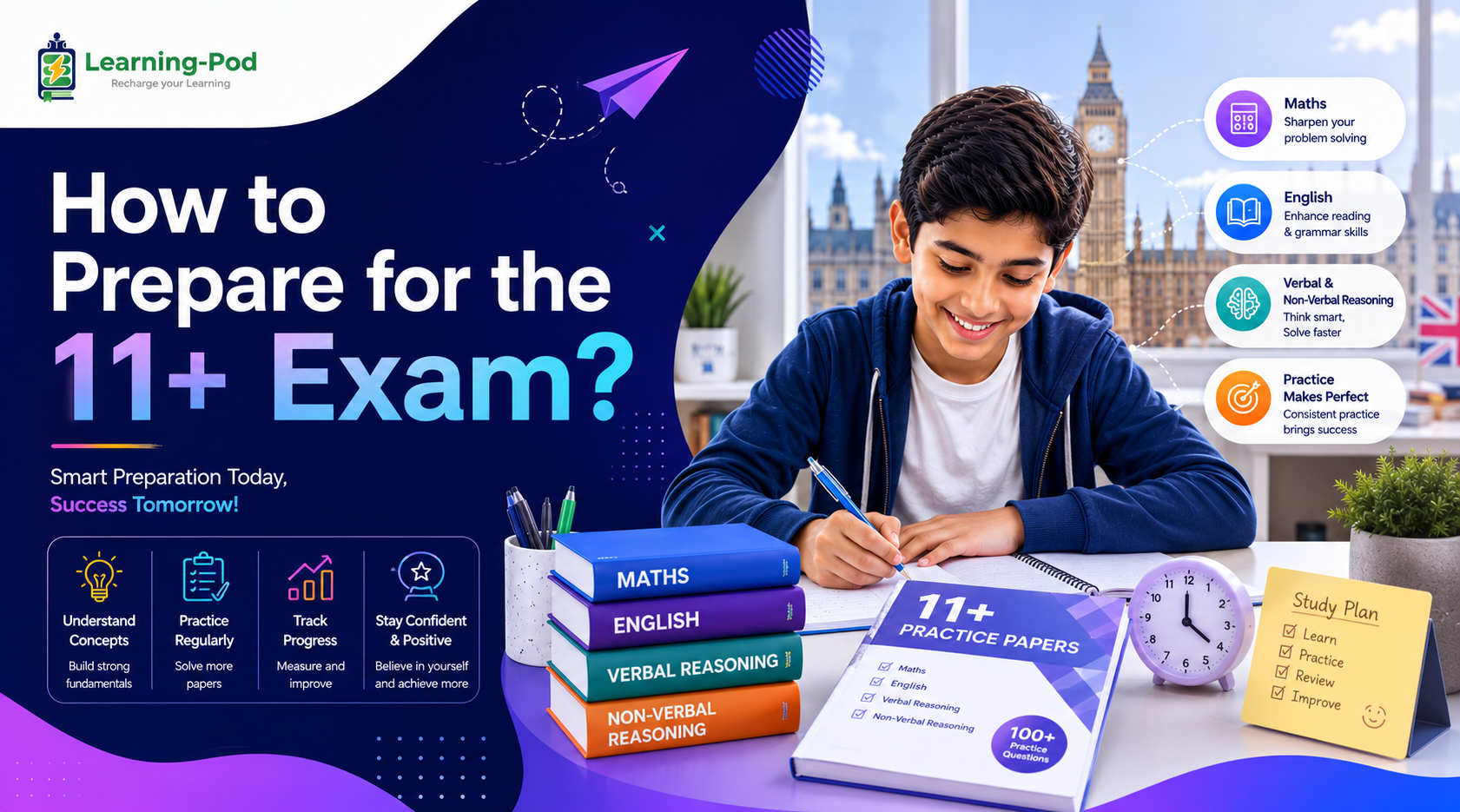
How to Prepare for the 11+ Exam: A Complete Guide for Parents
Preparing for the 11+ exam can feel like a big task, especially when your child is still in primary school. There is no single approach that works for every child. The right 11 plus preparation depends on the schools you are considering, the exam format used in your area, and your child’s current strengths and weaknesses.
A good preparation plan is not about making a child study for hours every day. It is about building strong Maths and English skills, developing reasoning ability, improving speed and accuracy, and helping your child feel comfortable with unfamiliar questions.
Start by Understanding the 11+ Exam
Before buying practice books or starting regular papers, find out exactly what your child will be tested on.
Different grammar schools, selective schools and regional consortia can use different entrance assessment formats. Depending on the school or consortium, the 11+ may assess:
- English
- Maths
- Verbal Reasoning
- Non-Verbal Reasoning
Some schools may also have additional requirements or use their own entrance assessments.
The exact combination of subjects, question types, timings and test format can vary considerably. Parents should therefore always check the latest admissions information published by each target school.
This is one of the most important steps in 11+ exam preparation. Spending months practising the wrong question types can waste valuable preparation time.
Check the admissions information for each school and establish:
- Which subjects are tested
- The test provider or assessment format
- The types of questions your child will encounter
- How long each section lasts
- Whether the test is paper-based or digital
- Registration and application deadlines
This is particularly important when considering grammar schools across Lancashire and the North West, Trafford, the Midlands, London and the South East, where entrance requirements can differ.
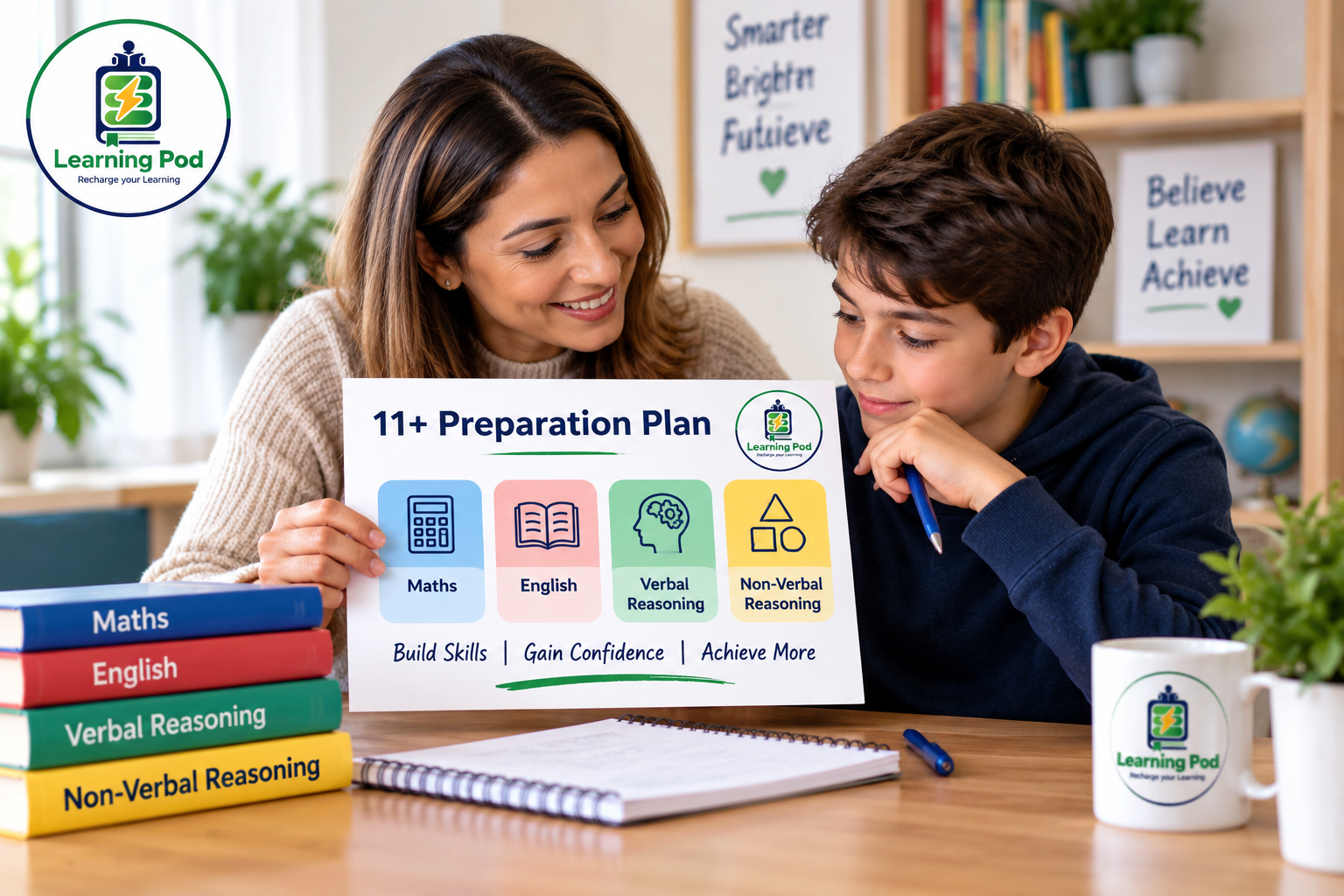
Build Strong Foundations Before Timed Tests
It can be tempting to start 11+ preparation by giving your child lots of practice papers. However, completing papers is much more valuable once the underlying knowledge and techniques are secure.
In Maths, check your child’s understanding of areas such as:
- Arithmetic
- Multiplication and division
- Fractions
- Decimals
- Percentages
- Problem solving
- Multi-step word problems
For English, focus on:
- Reading comprehension
- Vocabulary
- Spelling
- Grammar
- Punctuation
- Understanding and interpreting texts
Verbal and Non-Verbal Reasoning also require specific techniques. Children may need to recognise patterns, solve codes, complete sequences, identify relationships between words and numbers, or analyse shapes and diagrams.
At this stage, understanding should come before speed.
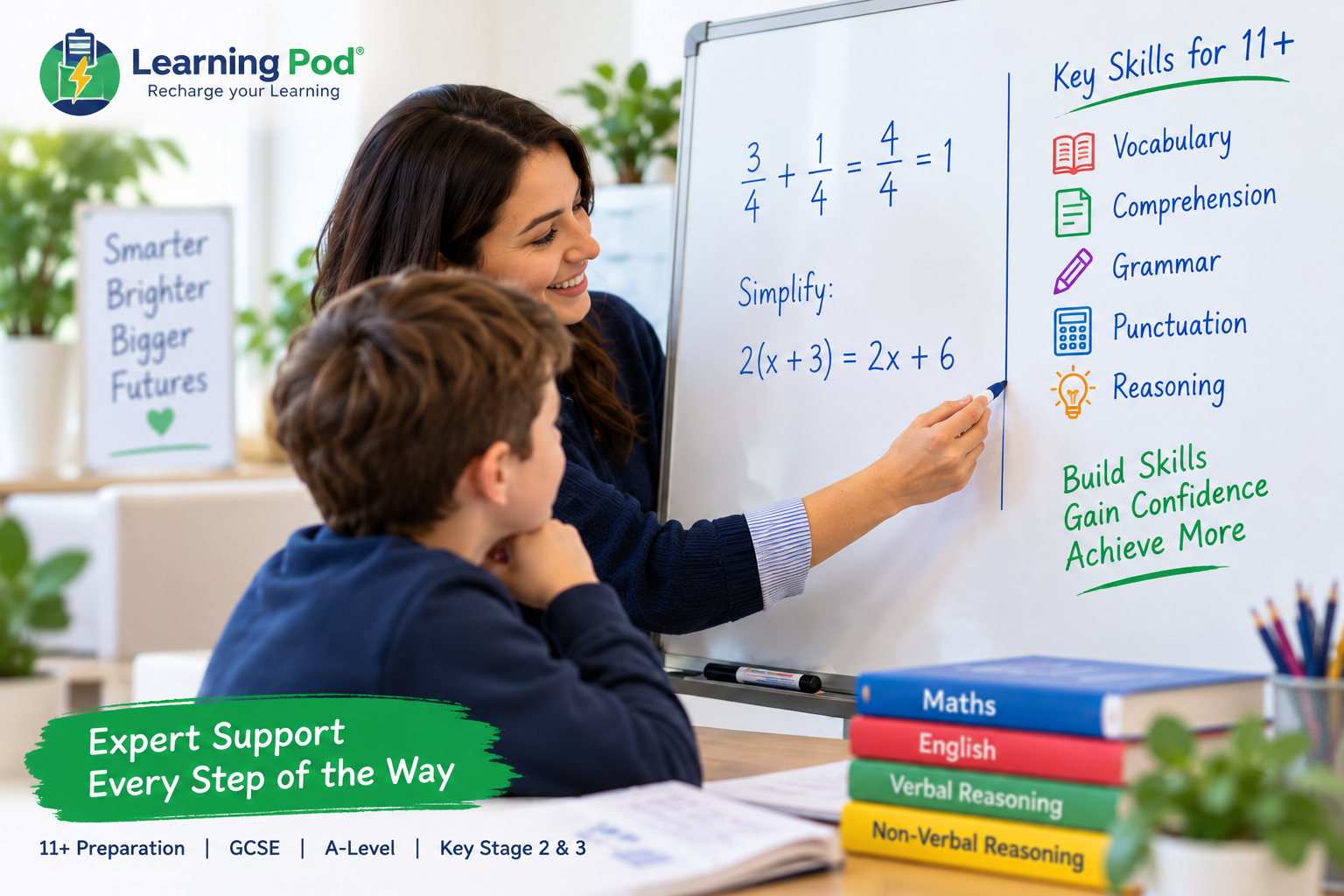
At Learning-POD, we don’t simply give children practice papers and worksheets. We teach the methods and techniques behind different question types, often working through problems step by step on the whiteboard.
The objective is for children to understand how and why a method works, so they can apply it confidently when they encounter unfamiliar questions.
Once those foundations are secure, timed practice becomes much more effective.
Make Reading Part of Everyday Life
Reading is one of the simplest and most valuable ways to support 11+ preparation at home.
Encourage your child to read a variety of books rather than relying entirely on exam materials.
Fiction can help develop vocabulary, comprehension, inference and understanding of characters and situations. Non-fiction exposes children to different writing styles, subjects and vocabulary.
After reading, occasionally ask questions such as:
What happened in this chapter?
Why do you think the character did that?
What do you think might happen next?
What does this word mean in this sentence?
Can you think of another word with a similar meaning?
These conversations encourage children to think about what they are reading rather than simply reading the words.
A child doesn’t always need to complete a worksheet to be learning. A strong reading habit can make a significant contribution to vocabulary, comprehension and confidence.
Create a Realistic Weekly Study Routine
Consistency is usually more effective than occasional long study sessions.
For 11+ preparation at home, divide the week into manageable sessions rather than trying to cover everything at once.
For example, a weekly routine could include separate sessions for:
- Maths
- English and comprehension
- Verbal Reasoning
- Non-Verbal Reasoning
- Reading and vocabulary
- Reviewing previous mistakes
As the entrance exam approaches, you can gradually introduce mixed exercises, timed sections and full practice papers.
The exact amount of study required will depend on your child’s age, ability and proximity to the exam.
Most importantly, keep sessions manageable enough for your child to remain focused. Continuing for another hour when a child is tired or frustrated often achieves very little.
The aim should be regular, purposeful preparation rather than excessive preparation.
Make sure children still have time for schoolwork, hobbies, family activities and rest.
Use Practice Papers in the Right Way
Practice papers are an important part of 11+ preparation, but simply completing one paper after another isn’t enough.
The real value comes from understanding what happened afterwards.
When reviewing a paper, consider:
Was the question wrong because the topic wasn’t understood?
Was the question misread?
Was the correct method used?
Was it a careless calculation?
Did your child run out of time?
Are the same types of mistakes appearing repeatedly?
Keep a simple record of recurring errors.
For example, if fractions repeatedly cause problems, spend time teaching and practising fractions rather than immediately giving your child another full paper.
This creates a useful cycle:
Test → Analyse → Teach → Practise → Retest
As your child’s knowledge improves, gradually introduce timed exercises. This helps develop speed and exam technique without making every learning session feel like an examination.
Consider Online 11+ Preparation
Online 11+ preparation can be useful when incorporated into a wider learning programme.
Digital resources can allow children to practise questions, receive immediate feedback and work independently for short periods.
They can be particularly useful for:
- Short practice sessions
- Vocabulary development
- Reasoning exercises
- Revisiting weaker topics
- Additional practice between lessons
However, online learning shouldn’t necessarily replace written work, reading, teacher-led explanation and paper-based practice.
Children should be comfortable solving problems independently and showing their working rather than relying solely on multiple-choice digital exercises.
A balanced programme combining tutor-led teaching, written work, reading, online practice and exam-style papers can provide useful exposure to different learning and question formats.
Introduce Mock Exams Before the Real Test
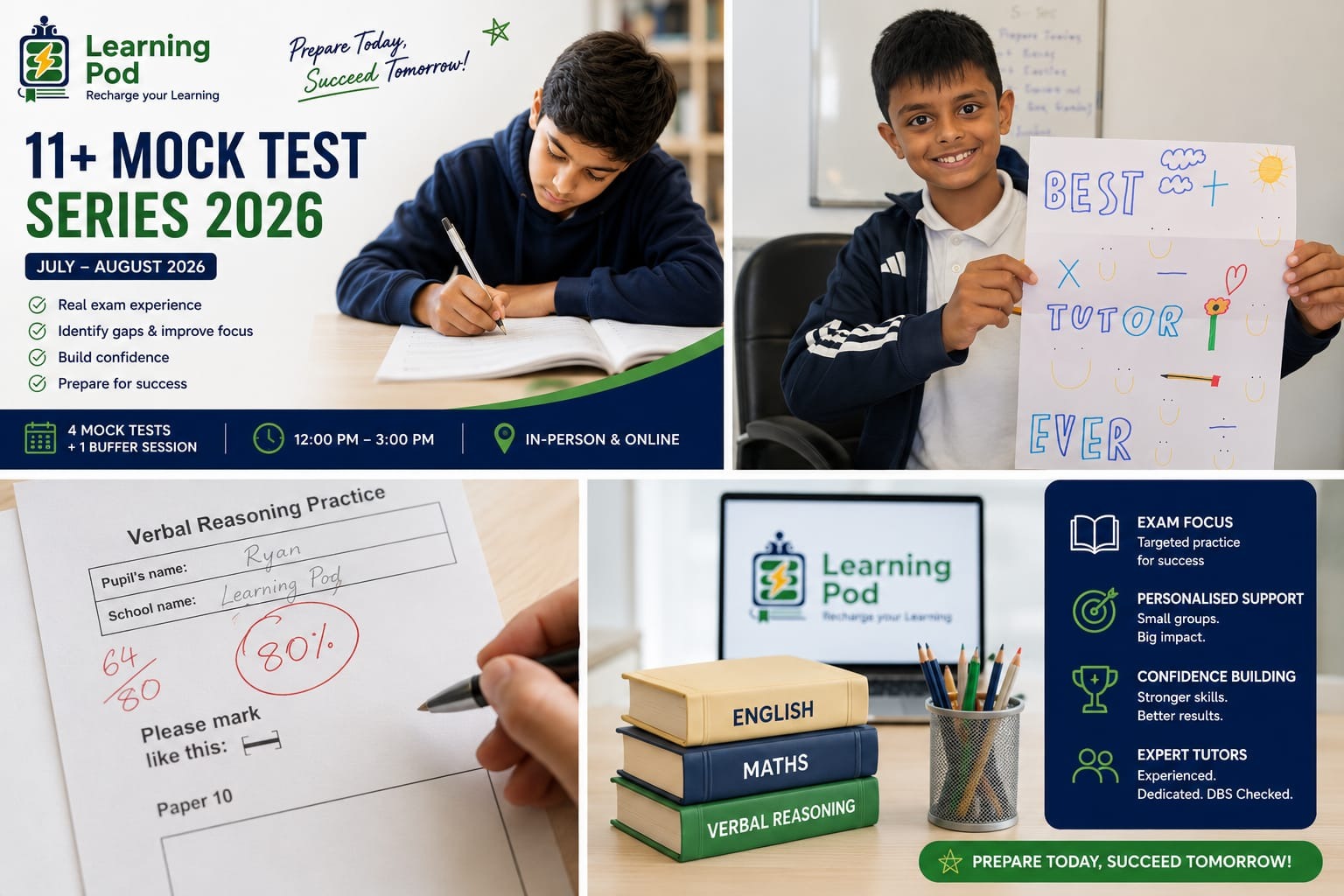
Mock exams are one of the most valuable stages of 11+ preparation once children have developed the necessary knowledge and techniques.
A good mock exam helps children experience what it feels like to:
- Work under timed conditions
- Complete several sections
- Manage their time
- Work independently
- Deal with difficult questions
- Maintain concentration for an extended period
However, the purpose of a mock exam isn’t simply to achieve the highest possible score.
The analysis after the mock is equally important.
A mock can identify topics requiring further teaching and reveal exam-technique issues such as spending too long on one question, rushing through easier questions or struggling to move on when an answer isn’t immediately obvious.
At Learning-POD, mock-test performance can be used to identify weaker areas and help guide the child’s subsequent preparation.
The objective should be:
Mock → Analyse → Identify Gaps → Targeted Teaching → Improvement
What If You Start Late?
Not every family starts preparing a year or more before the entrance examination.
If you’ve started later, don’t panic and don’t try to cover everything at once.
Begin by identifying your child’s biggest gaps and prioritise the subjects and question types that are relevant to the target school’s entrance assessment.
Use shorter, focused sessions and review mistakes carefully.
Prioritise:
- High-impact knowledge gaps
- Frequently tested skills
- Relevant question types
- Time-management techniques
- Exam familiarity
- Confidence
Avoid giving your child several complete practice papers every day simply because the exam is approaching.
Last-minute 11+ preparation should be targeted rather than overwhelming.
A focused revision programme can also help children consolidate key topics and practise important exam techniques shortly before the entrance examination.
Keep Your Child’s Confidence in Mind
Academic preparation matters, but confidence matters too.
A child who believes every mistake means they are failing may become anxious and lose concentration.
Instead, use mistakes as useful information.
A wrong answer tells you something: perhaps a topic needs teaching again, a technique hasn’t been fully understood, or the child simply needs more practice.
Encourage children to see challenging questions as part of the learning process.
Praise improvement, persistence and good problem-solving rather than focusing solely on scores.
It’s also important to remember that the 11+ is only one route into secondary education. Having realistic alternative school choices can reduce unnecessary pressure and help children approach the entrance examination more calmly.
The goal should be to help your child enter the examination thinking:
“I’ve prepared well, I know what to expect, and I’m ready to do my best.”
11+ Preparation Across the UK
11+ entrance requirements aren’t identical across the country.
Families considering grammar schools in Lancashire, Trafford and other parts of the North West may encounter different assessment arrangements from families applying to grammar schools in the Midlands, London or the South East.
Even schools within the same wider region can have different admissions criteria.
Parents should therefore check the current admissions information for every school they’re considering rather than assuming that preparation for one grammar school will automatically cover another.
This should include checking the school’s:
- Entrance examination format
- Subjects tested
- Registration dates
- Examination dates
- Admissions criteria
- Catchment requirements, where applicable
Understanding the destination should come before designing the preparation plan.
How Learning-POD Can Help with 11+ Preparation
At Learning Pod, we believe successful 11+ preparation begins with understanding the individual child.
Our approach starts by considering your child’s current ability, target schools, strengths and areas requiring development. We can then create a structured preparation plan covering the relevant areas of Maths, English, Verbal Reasoning and Non-Verbal Reasoning.
Importantly, we don’t simply hand children worksheets and expect them to work through hundreds of questions.
Our focus is on teaching.
We explain methods and techniques, work through problems step by step, and help children understand how to approach different types of questions. This means they are better equipped to tackle questions they haven’t seen before rather than relying on memorised answers.
Our structured approach can include:
Assessment → Personalised Plan → Methodical Teaching → Targeted Practice → Progress Review → Mock Exams
As children progress, we introduce appropriate timed practice and exam-style questions to help improve knowledge, speed, accuracy, exam technique and confidence.
Learning-POD provides 11+ preparation for families in Preston and Lancashire, Trafford and the North West, the Midlands, London and the South East, with both in-person and online learning options where appropriate.
Ready to Start Your Child’s 11+ Preparation?
If you’re unsure where your child should begin, an initial assessment can help identify their current strengths, knowledge gaps and preparation priorities.
Contact Learning-POD to discuss your child’s target schools and 11+ preparation requirements.
Final Thoughts
Successful 11+ exam preparation isn’t about completing the greatest number of worksheets or practice papers.
It’s about preparing intelligently.
Start by understanding the entrance examination your child will actually sit. Build strong foundations in Maths and English, develop reasoning techniques, encourage regular reading and introduce timed practice when your child is ready.
Most importantly, analyse mistakes rather than simply counting scores.
Whether you choose 11+ preparation at home, online learning, small-group tuition or individual support, consistency and quality of preparation are more important than trying to do everything at once.
With a clear plan, strong foundations, effective teaching and appropriate exam practice, children can approach the 11+ with stronger skills, better exam technique and greater confidence.
Frequently Asked Questions About 11+ Preparation
1. When should my child start preparing for the 11+ exam?
Most children benefit from starting structured preparation around Year 5, although the ideal time depends on the child’s current ability and the exam date. Starting earlier can help build skills gradually without creating too much pressure.
2. How can I prepare my child for the 11+ exam at home?
For 11 plus preparation at home, create a simple weekly routine covering Maths, English, Verbal Reasoning and Non-Verbal Reasoning. Include regular reading, practice questions and timed tests, while reviewing mistakes to identify areas that need more attention.
3. Is online 11+ preparation effective?
Yes. 11 plus exam preparation online can provide structured practice, instant feedback and flexible learning. However, online study works best when combined with reading, written exercises, mock tests and guidance suited to your child’s needs.
4. What should my child do during 11+ last-minute preparation?
With 11 plus last minute preparation, focus on important topics, common question types and exam technique rather than trying to learn everything again. Short, focused sessions and timed practice can be more useful than long study hours.
5. How can I help my child stay confident during 11+ preparation?
Keep preparation consistent but avoid putting too much pressure on scores. Praise effort and improvement, discuss mistakes calmly and make sure your child has enough time for rest, hobbies and normal family activities. Confidence can make a significant difference on exam day.